
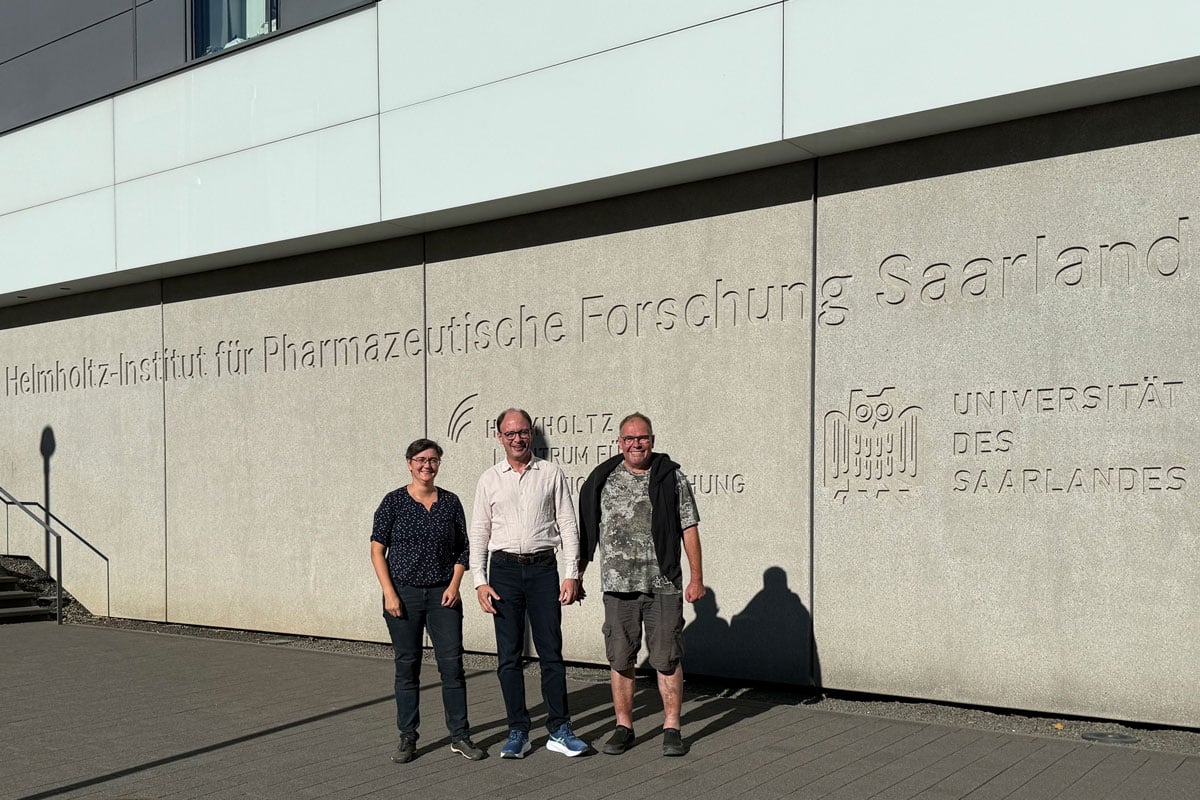
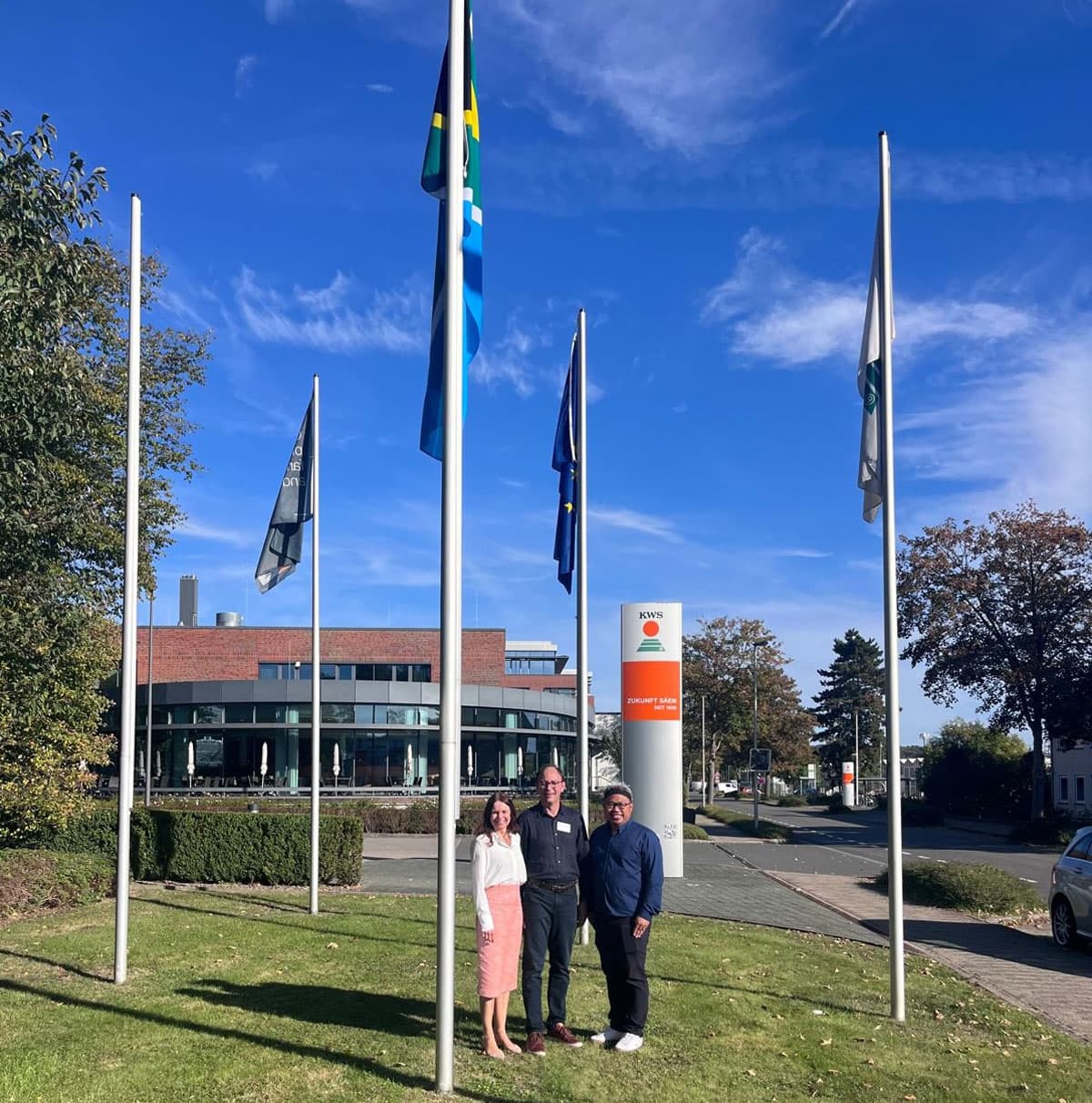
During his Alexander von Humboldt Foundation Research Award stay in Germany, Prof. Bernard Slippers visited two partners whose work connects closely with FABI's research: the plant breeding company KWS in Einbeck, and the Helmholtz Institute for Pharmaceutical Research Saarland (HIPS) in Saarbrücken. Both visits, in late September 2026, built on long-standing relationships and explored how complementary expertise and resources can be connected. At KWS, Bernard met Dr Kerstin Krüger, lead phytopathologist of the KWS Group and a former member of FABI, at the company's impressive and expanding facilities. He was joined by Dr Rene Heim of the University of Göttingen, who combines plant pathology with sensors, remote sensing and related data science, and is also part of the Satellite Lab in Remote Sensing of Plant Health at FABI. These fields are clearly relevant to the exceptional digital resources KWS is developing. The discussions focused on the challenges and opportunities for precision plant health management in a changing world, and on how the partners' expertise and resources might be connected to advance these objectives. In Saarbrücken, Bernard visited Prof. Christine Beemelmanns, who leads the Anti-Infectives from Microbiota group at HIPS and holds a professorship at Saarland University, together with Prof. Marc Stadler of the Helmholtz Centre for Infection Research (HZI). Their facilities and human capacity for the discovery and development of secondary metabolites are world class, and growing. FABI has collaborated with both for many years, and is a partner with them in Mycobiomics 2.0, a Marie Skłodowska-Curie Actions project under Horizon Europe coordinated by Prof. Stadler. The project links 13 institutions in 11 countries in the search for new anti-infective compounds from fungi. Together, the two visits reflect how FABI's partnerships span fields and sectors, from precision plant health in agriculture to fungal chemistry and drug discovery. As Bernard noted after the visit, there are more fungi, more chemicals, more world-class science and training, and more solutions to come.