Genomic insights into trichome and inflorescence evolution of the palaeopolyploid tree genus Greyia
Research highlight
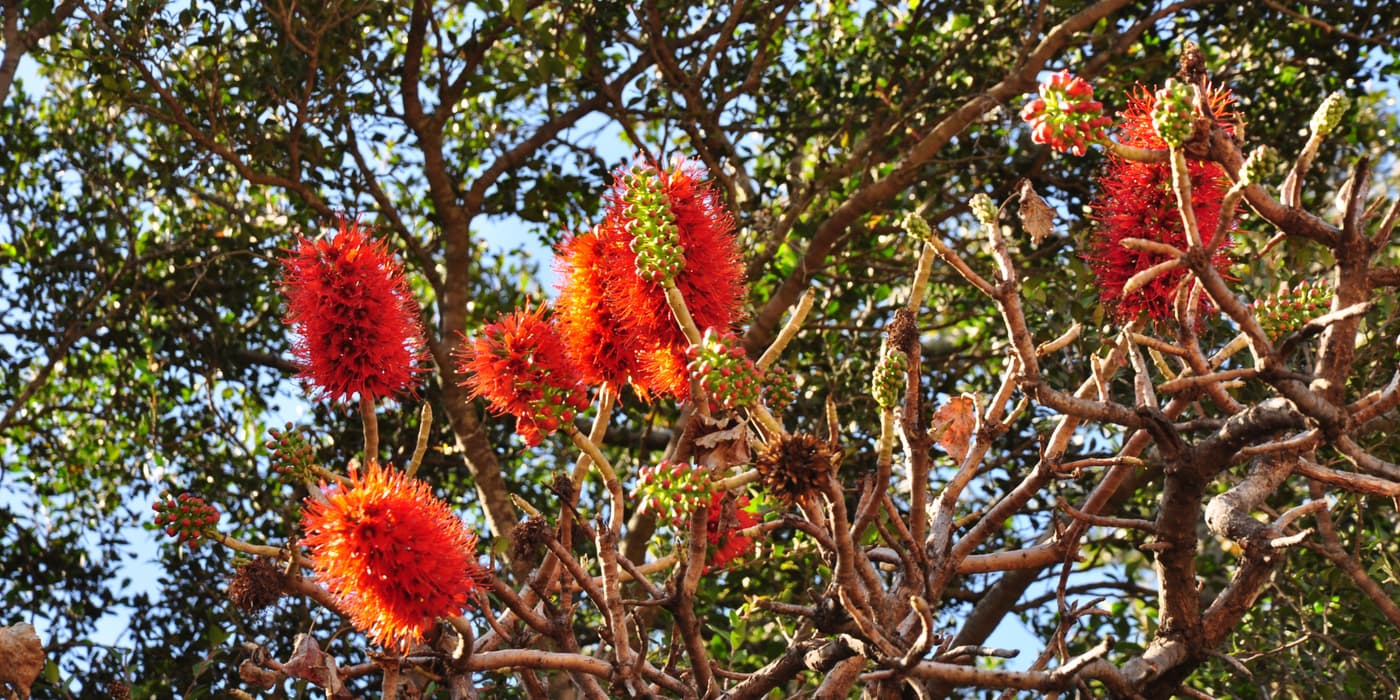
Researchers have successfully sequenced the genomes of all three species of the South African tree genus Greyia. This breakthrough study provides the first comprehensive genetic blueprint for these fascinating endemic plants, revealing how ancient genetic events shaped their striking flowers and specialized leaf hairs.
Greyia is a "palaeopolyploid" meaning its entire genome was duplicated at least once in its ancient evolutionary past. This provided a pool of "spare" genetic material, allowing the plant to “experiment” and evolve new physical traits over millions of years without losing essential survival functions.
By analyzing the three newly sequenced genomes side-by-side, the research team discovered that a whole-genome triplication was a key driver in the evolution of two distinct botanical features: their complex flower clusters (inflorescences) and their trichomes (tiny, hair-like structures on the leaves).
The leaves of Greyia have well-documented medicinal activity, and plant trichomes often serve as microscopic biofactories that produce these valuable therapeutic compounds. Understanding the genetic origins of these traits not only resolves fundamental questions about how unique South African plants adapt, but also establishes a critical foundation for future biotechnology, conservation, and natural healthcare applications.
Abstract
The southern African endemic tree Greyia Hook. & Harv. (Francoaceae, Geraniales) comprises three species distinguished by striking variation in trichome morphology and inflorescence architecture, yet the genomic and regulatory basis of these traits has remained largely unexplored. Here, we present chromosome-scale genome assemblies for all recognised Greyia species, namely Greyia radlkoferi, Greyia sutherlandii, and Greyia flanaganii, providing the first high-quality genomic resources for Geraniales. Phylogenomic analyses placed Geraniales as sister to Crossosomatales, with divergence at ~103 million years ago (Mya), and indicated that Greyia diversified recently during the Quaternary (~1.39 Mya). Comparative genomics revealed a Greyia-specific palaeo-hexaploidisation event dated to ~87 Mya, followed by fractionation but with extensive retention of ancestral gene sets in either triplicated or duplicated states across syntenic regions. Transcriptomic analyses revealed regulatory divergence in the conserved MYB–bHLH–WD40 (MBW) network likely associated with variation in trichome morphology, including undetectable GL1 expression and altered GL3/EGL3 expression in G. sutherlandii. In addition, analyses of flower and inflorescence traits identified expansion of MADS-box transcription factor families and species-specific cis-regulatory divergence in LFY and FT. Notably, predicted AGL6 binding sites are retained in the LFY and FT promoters of G. radlkoferi and G. sutherlandii but absent in G. flanaganii, consistent with differences in inflorescence density among species. Together, these results demonstrate how polyploidy and regulatory divergence of conserved developmental pathways have shaped morphological diversification in Greyia.