
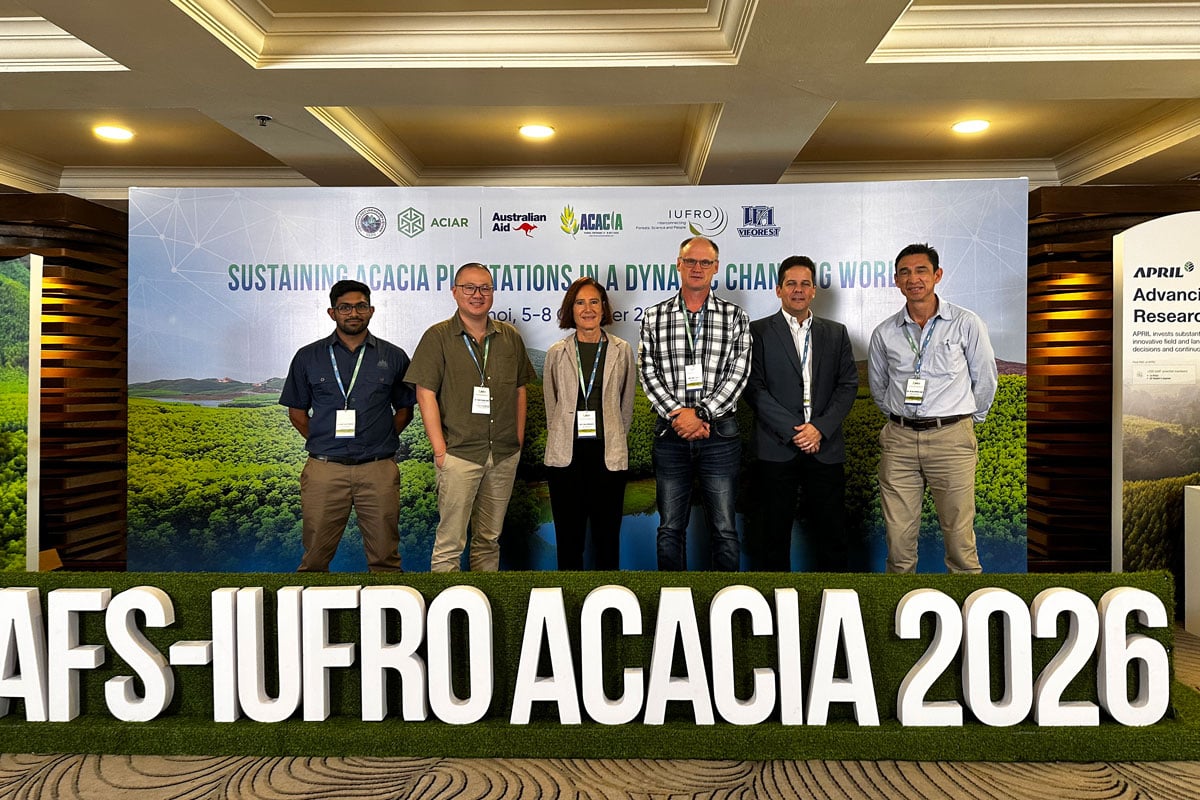
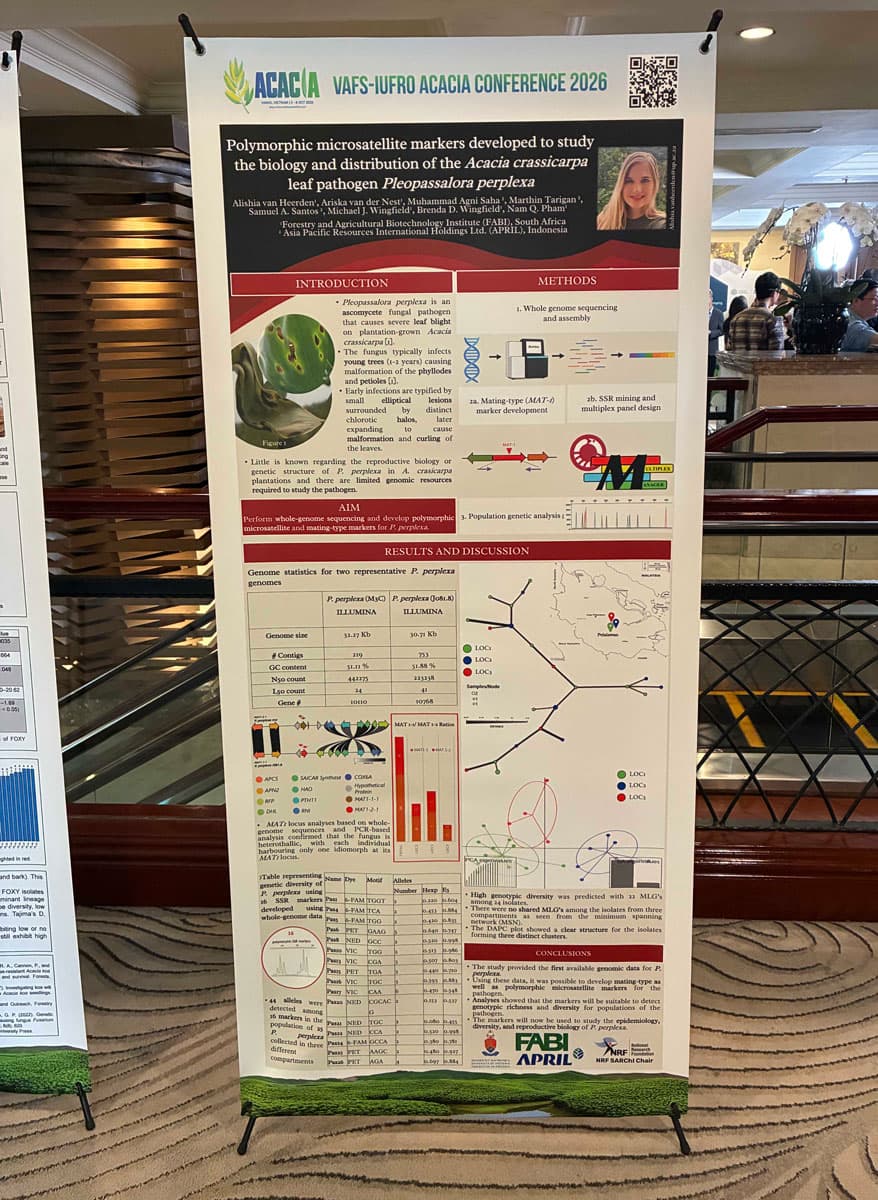
Dr Nam Pham and Prof. Brett Hurley attended the IUFRO ‘Sustaining Acacia plantations in a dynamic changing world’ conference in Hanoi, Vietnam. Dr Pham presented on ‘Genomics promotes opportunities to manage Acacia leaf pathogens in southeast Asian plantations’, while Prof. Hurley presented on ‘Australian Acacias beyond their native range: confronting insect pests and pathogens’.
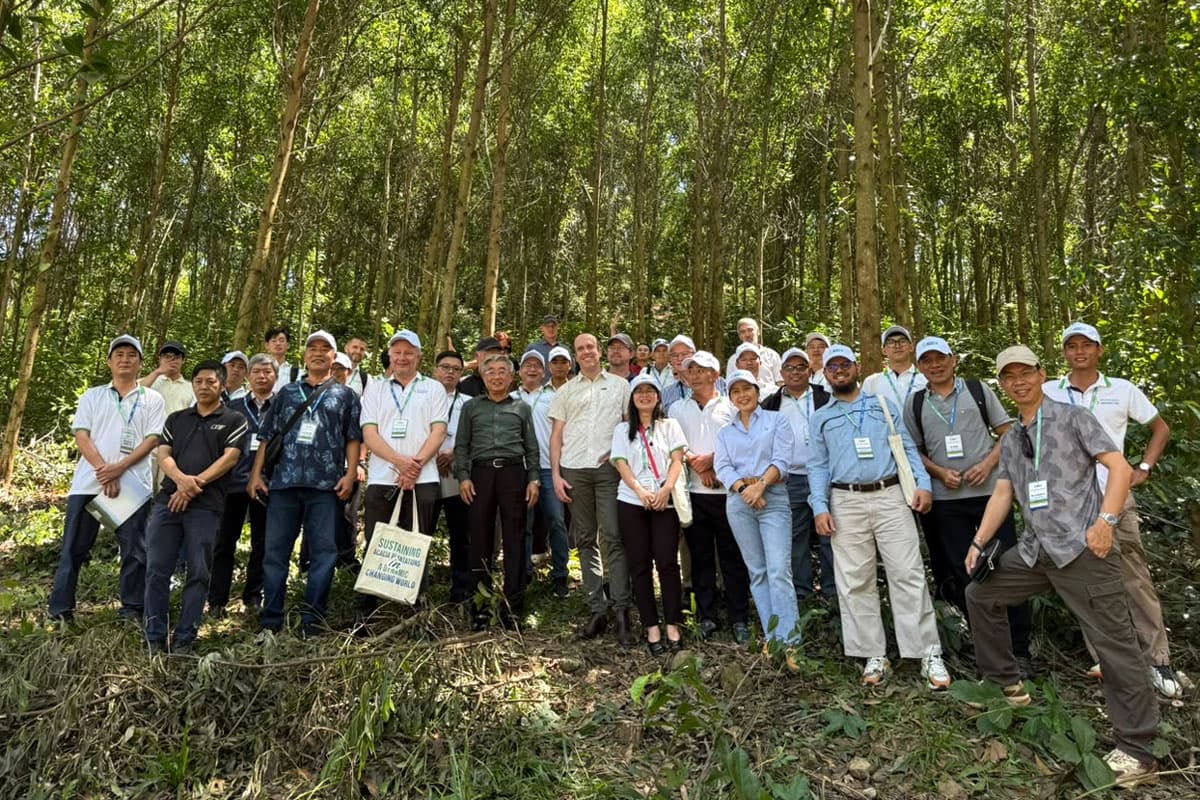
The meeting provided a broad range of presentations across breeding and biotechnology applications, silviculture and sustainable management, and forest products, value chains and markets. There were also field trips to demonstrate Vietnam’s forestry value chain, and tree breeding from clonal propagation to deployment.
Acacia is an important plantation genus for FABI’s research programmes. The Tree Protection Co-operative Programme (TPCP) at FABI conducts research on pests and pathogens of plantation forest trees in South Africa, including Acacia mearnsii (Black wattle) where the bark extract is used to produce tannins, and the timber is used for charcoal, firewood, and woodchips exported for pulp. The TPCP is also involved in research on A. mearnsii in Ethiopia through the ‘Management of Pests and Diseases of Forest Crops in Ethiopia’ project funded by ACIAR.
The RGE-FABI Tree Health Programme provides research support on pests and pathogens for Asia Pacific Resources International Limited (APRIL Group) in Indonesia, where A. auriculiformis, A. crassicarpa, A. mangium and hybrids, are planted for use in various products such as pulp, paper, viscose staple fibre, paperboard and tissue.
The meeting was a valuable opportunity to exchange ideas with Acacia researchers and industry partners from around the world, and to build connections that will support FABI’s ongoing work on Acacia health.