Research Visit to Penn State University, Home of the Nittany Lions
FABI PhD student Andi Wilson relates her experiences while on a two month research visit to Department of Plant Pathology at Pennsylvania State University.
Prof. Brenda Wingfield gives us an insight of campus life while on sabbatical at Pennsylvania State University.
Two FABIans were re-elected to the executive committee of the Gauteng branch of the Southern African Institute of Forestry (SAIF). The SAIF is a professional association of forestry-related experts geared towards delivering a professional service to forestry. Four FABIans were among six presenters at the meeting who rose to the challenge of PechaKucha style talks on forestry matters. George Dowse of Hans Merensky’s presentation was titled Breeding Eucalyptus sawtimber, Kassahun Maru of UP discussed “The importance of agroforestry in Ethiopia”, Izette Greyling presented “Field extension: Linking industry to world class research”, Darryl Herron presented “Plant clinics in the Anthropocene”, Tayo Adenigba’s presented her talk “Can we use mating factors to manage pitch canker?
Two leading Rhizobium researchers, Dr Sofie de Meyer form the Centre for Rhizobium Studies at Murdoch University in Perth, Australia and Dr Euan James from the James Hatton Institute in Scotland presented a special seminar at FABI as part of their visit to the Institute. Dr de Meyer explained how researchers at the Centre for Rhizobium Studies is focused on finding new legumes better adapted to future climatic conditions in Australia. Dr James spoke of his research work on the diversity of Beta-rhizobia on Mimosa species in South America with the principle questions i) who are these symbionts, ii) what is their origin and iii) are they associated with specific legume hosts?
FABIans got together on 30 May to bid farewell and to wish Zandile Mngadi well on her last day at the Institute.
During the first week of May an Outreach Team of the CTHB participated in the annual Career Guidance Week hosted by the Mondi Science, Career Guidance and FET Skills Centre in Piet Retief, Mpumalanga.
The Tree Protection Co-operative Programme (TPCP) in FABI hosted its 28th annual symposium on 16 and 17 May at the University of Pretoria.
Indigenous tree health was brought under the spotlight at the annual meeting of the DST-NRF Centre of Excellence in Tree Health Biotechnology at FABI on 15 May.
Congratulations to Velushka Swart on the successful defence of her PhD degree on 18 May! Her project was supervised by Prof. Velushka’s research sought to understand the role of cercosporin, a phytotoxin that was thought to be essential for pathogenicity in Cercospora species that are pathogens on different hosts.
The situation the world’s population currently finds itself in with the global-spread of the COVID-19 virus - just one invisible pathogen - bears direct parallels to the research work that has been done in the TPCP over the past 31 years in combatting plantation tree pests and diseases. The TPCP’s research activities support the development of integrated pest management strategies for the South African forestry industry. When dealing with a new disease outbreak the first response is containment to limit its spread - not unlike the lockdown implemented in most parts of the world in response to the COVID-19 pandemic. The next step is to identify the causal agent (bacterium, fungus, insect or virus) of the epidemic. All of this research, taken together, will help the TPCP and its partners to develop integrated pest and pathogen management strategies/or control for the South African forestry industry. The TPCP also takes a pro-active approach to consider possible future threats to the domestic forestry industry in order to prepare for them. View a recording of Prof.
The University of Pretoria ranks second in the world in Mycology based on the research output of FABI over the past ten years.
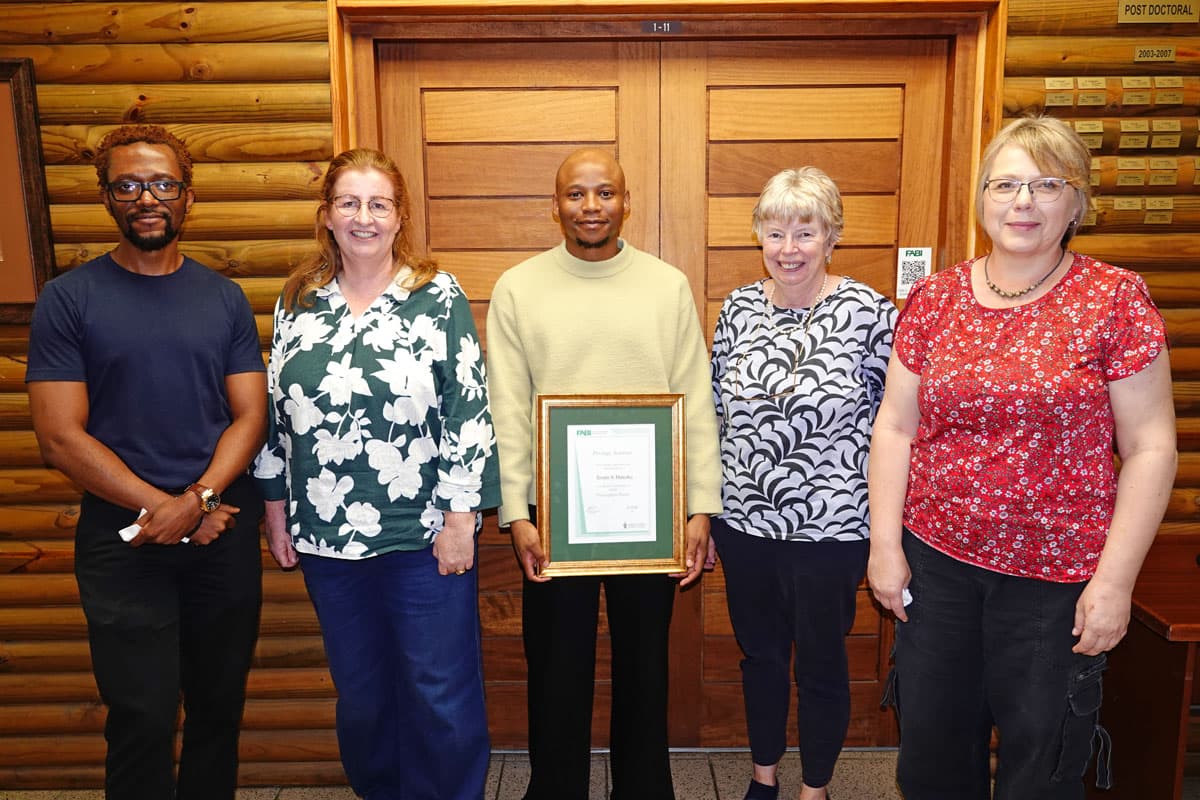
James Mehl is the fourth doctoral candidate in FABI to complete a PhD degree in 2017.
Seven researchers affiliated with FABI were among those honoured at the University of Pretoria’s annual Academic Achievers’ Awards ceremony on 9 May.
As part of their course in Crop Protection, second and third year students from the University of Pretoria visited the FABI Biocontrol Centre. The stops were: 1. 2. 3. 4. The practical was organised by Dr Michelle Schröder, with assistance from Ms Samantha Bush, Ms Zandile Mngadi, Mr Osmond Mlonyeni, Mr Joseph Khadile and Dr Brett Hurley.
FABIans bid farewell to two of their own – Drs Stuart Fraser and Birhan Abate – on 4 May.
FABI would like to congratulate the 25 FABIans that graduated at the University of Pretoria’s Autumn Graduation ceremony on 2 May.
Danielle Roodt, a FABI PhD student, won a Whitehead Scientific travel grant.
More than fifty students and postdoctoral fellows used nearly 200 bags of potting soil to replant a record-breaking 4800 cuttings and seedlings into potting bags at the FABI nursery on 21 April.
For two weeks in March, FABIans will be privy to the skills and knowledge of Dr. Robert Waterhouse, an expert on comparative evolutionary and functional genomics of arthopods, and particularly disease-vector mosquitoes, from the Department of Ecology and Evolution at the University of Lausanne in Switzerland.
FABI’s Molecular Plant-Pathogen Interactions (MPPI) research group added value to their ongoing survey of fungal diseases in small-holder maize farms in KwaZulu-Natal and the Eastern Cape Provinces by disseminating information about FAW to provincial agricultural extension officers and small-holder farmers.
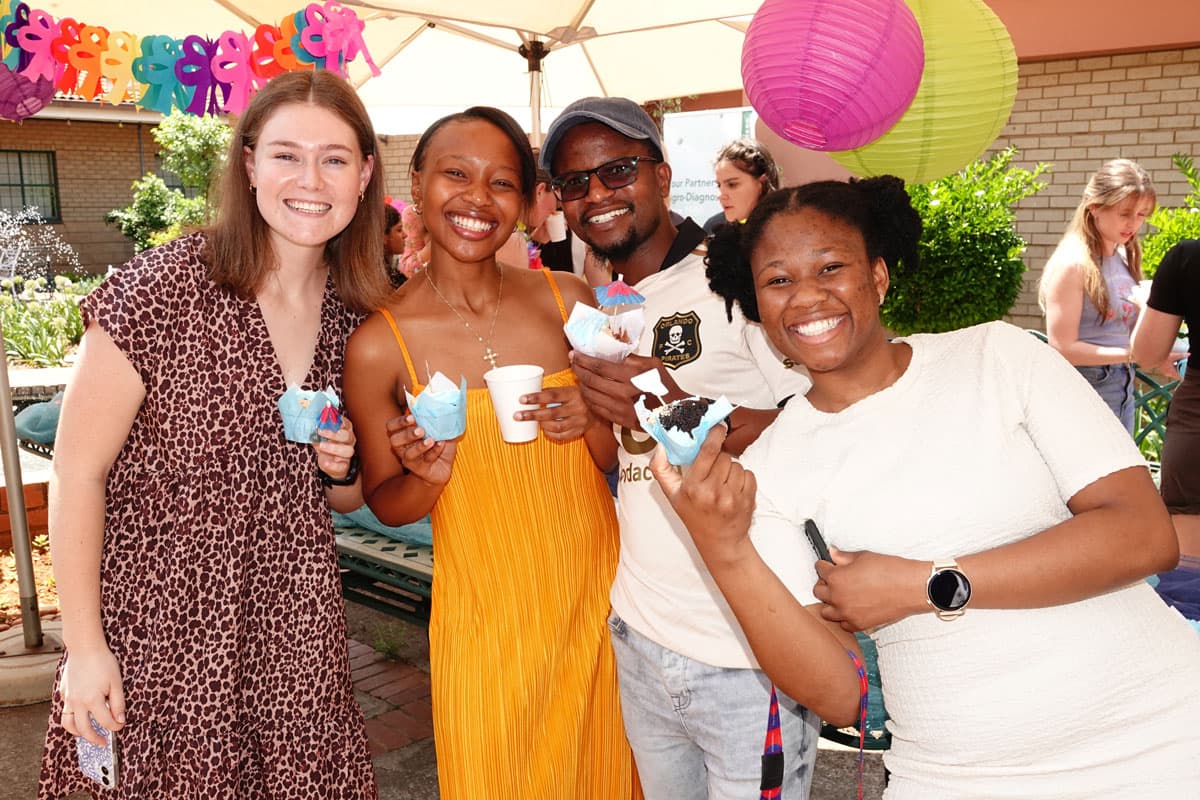
FABI’s 2017 social calendar set off to a cracking start with an Easter-egg themed party on 19 April.
The Sci-Bono Discovery Centre in Johannesburg aims to help build South Africa’s science, engineering and technology capacity, especially through activities with learners.
FABIans set a new record in 2016 for the highest number of publications since the Institute was established in 1998.
The Forestry Molecular Genetics (FMG) research group in FABI had its first tree planting day of the year.
A delegation of five postdoctoral and doctoral students, and a technical staff member from FABI presented at the 8th IUFRO Phytophthora in Forests and Natural Ecosystems Meeting in Vietnam.
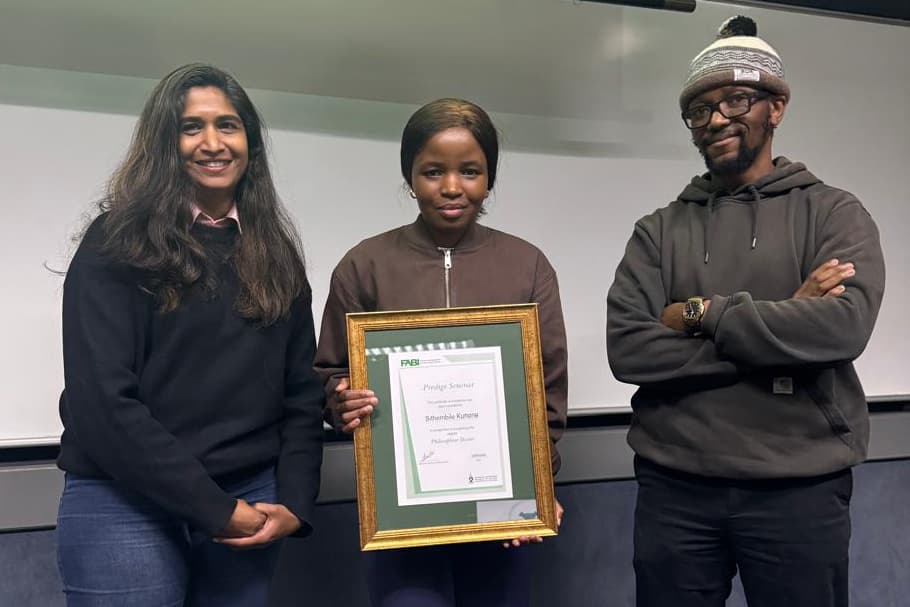
Phathi Sibanda is the latest postgraduate student at FABI to complete a PhD degree in 2017. She marked the occasion by delivering her prestige seminar in front of her family, friends and colleagues on 22 March.
During the week of 13th March, FABI Director Prof. Mike Wingfield visited Freiburg in Germany, primarily to meet with colleagues responsible for organising the IUFRO 125th Anniversary Congress to be held in Freiburg from 18-22 September 2017.
Dr. Michelle Schroder, a postdoctoral fellow at FABI is spending two months collaborating with researchers at the University of the Sunshine Coast’s (USC) Forest Industries Research Centre.
The European spruce bark beetle, Ips typographus, is the most damaging insect pest of palearctic forests.
FABI welcomed 17 DST-NRF Centre of Excellence in Tree Health (CTHB) mentorship students at a function on 3 March.
Several FABI academics participated in a recent landmark International Practical Synthetic Biology Workshop sponsored by the Global Challenges Research Fund (GCRF).
FABI has launched its Annual Blanket Drive in aid of those in need of warmth this coming winter. FABIans donated 200 blankets last year to Meet and Eat, an initiative run by six church dominations that provides meals for homeless people in the Hatfield and Hillcrest suburbs.
FABI has been developing relationships and collaborations with researchers at the Forest and Forest Product Research Institute (FFPRI) in Japan since 2007.
The Forestry and Agricultural Biotechnology Institute (FABI) and Southern African Macadamia Growers’ Association (SAMAC) have established a collaborative research partnership, the Macadamia Protection Programme (MaPP). This programme will address the threats posed by pests and diseases to Macadamia farming in South Africa.
During the past week, Prof. David Sillam-Dussès from the University of Paris visited FABI to do some field work as part of a collaborative research project.
Quentin Guignard, a PhD student in FABI, attended a camp for new Honours students organised by the University of Pretoria’s Department of Zoology and Entomology at the Kwalata Lodge in the Dinokeng Reserve from 7-10 February.